How cast iron sewer pipe corrodes
Cast iron rusts from two directions at once. From the inside, hydrogen-sulfide gas generated by anaerobic bacteria in the sewer flow combines with humidity at the pipe crown to form sulfuric acid, which slowly etches the upper wall. From the outside, soil moisture and seasonal frost cycling drive electrochemical oxidation, especially where the pipe contacts dissimilar materials at fittings. In Minnesota, the additional stress of 42–60 inch frost depth cycling (per MN DLI 1303.1600) accelerates the spalling of protective scale, exposing fresh metal each spring.
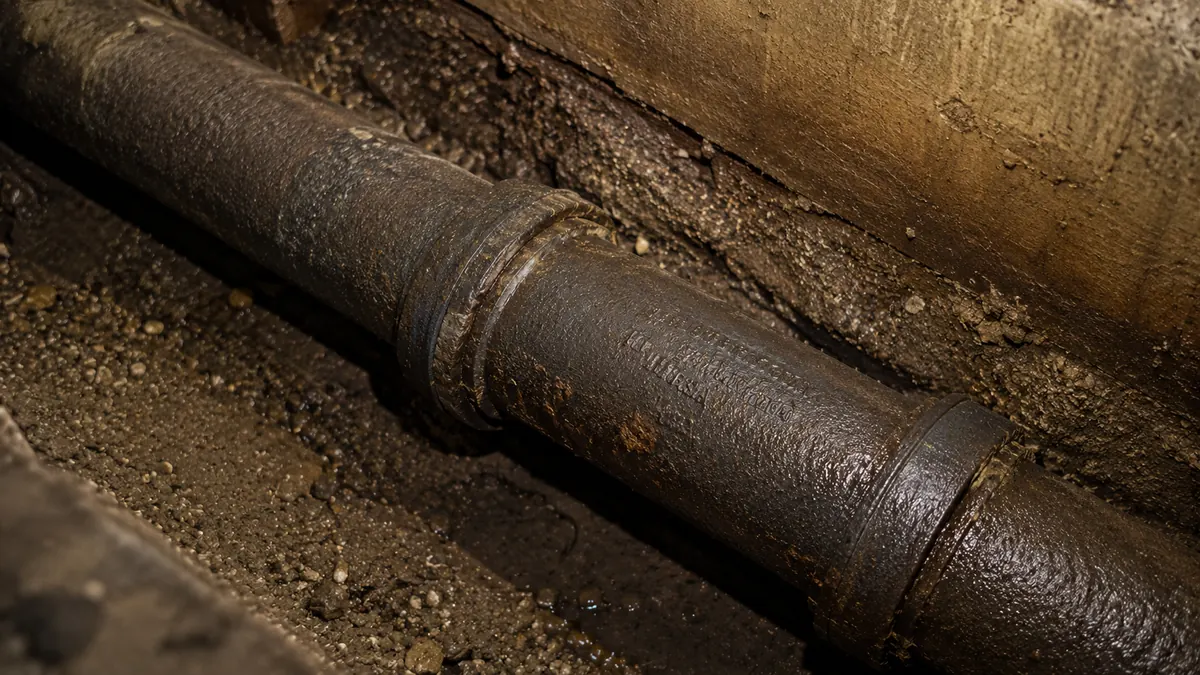
The four corrosion patterns we see on camera
- Scale (tuberculation). Brown-orange knobby mineral deposits adhered to the pipe wall. Reduces effective diameter and catches debris. Most common on the bottom third of the pipe.
- Channeling. A U-shaped groove worn into the bottom of the invert by years of acidic wastewater flow. Severe channeling can reach half the original wall thickness.
- Pitting. Localized holes through the wall, often clustered along the spring line of the pipe. Indicates active rust-through.
- Crown attack. The upper interior of the pipe goes from smooth black to scaly brown to visibly cratered. Sulfide-acid-driven and progressive.
Severity grading
| Grade | Wall loss | Channel depth | Action |
|---|---|---|---|
| LOW (CI-1) | < 20% | Surface scale only | Monitor, re-scope 3 yr |
| MEDIUM (CI-2) | 20 – 40% | < ¼ wall | Plan CIPP liner |
| HIGH (CI-3) | 40 – 60% | ¼ – ½ wall | Liner or burst, soon |
| CRITICAL (CI-4) | > 60% / pitting | > ½ wall | Replacement now |
Across 5,113+ Minnesota inspections we have documented, 71% of pre-1955 cast iron laterals show CI-2 or higher corrosion, and the median useful life remaining at first scope is just 7 years.
Repair options
- Descaling + CIPP liner. A robotic cutter clears scale, then a resin-impregnated liner is cured inside the host pipe. Works for CI-2 and most CI-3 cases. 50-year design life.
- Pipe bursting. Replaces the entire lateral with HDPE. Appropriate for CI-3 to CI-4 cases where lining is risky.
- Open-trench replacement. Required for severe pitting, multiple fractures, or runs under driveways where bursting paths are blocked.
- Above-grade cast iron stack replacement. Inside-the-house cast iron stacks corroded at the basement floor are replaced with PVC or no-hub cast during a renovation. Different from buried lateral work.
Cost ranges (Twin Cities 2026)
| Method | Typical Cost |
|---|---|
| Descale + CIPP spot liner | $3,000 – $6,500 |
| Descale + full CIPP liner | $8,000 – $15,000 |
| Pipe bursting (cast iron) | $9,000 – $20,000 |
| Open-trench replacement | $14,000 – $30,000 |
| Interior stack replacement | $3,500 – $9,000 |
Frequently Asked Questions
What causes cast iron sewer pipe corrosion?
Cast iron sewer corrosion is driven by hydrogen sulfide gas attack on the upper pipe walls, oxygen-driven rusting on the bottom invert, and electrolytic action where dissimilar metals meet. In Minnesota, freeze-thaw cycling accelerates scale spalling.
How long does cast iron sewer pipe last in MN?
Cast iron typically lasts 50–100 years depending on water chemistry and bedding. Pre-1955 MN homes are now at the end of that range, and we routinely document advanced channeling and scale buildup on 80+ year-old laterals.
What is channeling in cast iron sewer pipe?
Channeling is a U-shaped groove worn into the bottom of a cast iron pipe by years of acidic wastewater flow. Once channeling reaches half the wall thickness, structural integrity is compromised and replacement is recommended.
Can a corroded cast iron sewer line be lined?
Yes, if the host pipe retains enough wall thickness to support the liner during cure. A CIPP liner is rated for 50 years even when installed in heavily scaled cast iron — but advanced channeling or rust-through requires excavation or bursting.
How much does it cost to replace cast iron sewer in the Twin Cities?
Pipe bursting a full cast iron lateral runs $9,000–$20,000 in the Twin Cities. Open-trench replacement runs $14,000–$30,000. A CIPP full liner runs $8,000–$15,000 when the host pipe is viable.
Is galvanized drain pipe the same problem?
Galvanized steel was used for vertical drains and short runs from sinks. It corrodes from the inside, narrowing the bore and eventually leaking. Replacement with PVC or copper during a renovation is standard.